
Memory Semiconductor Market 2026: What the Market Is Telling Businesses
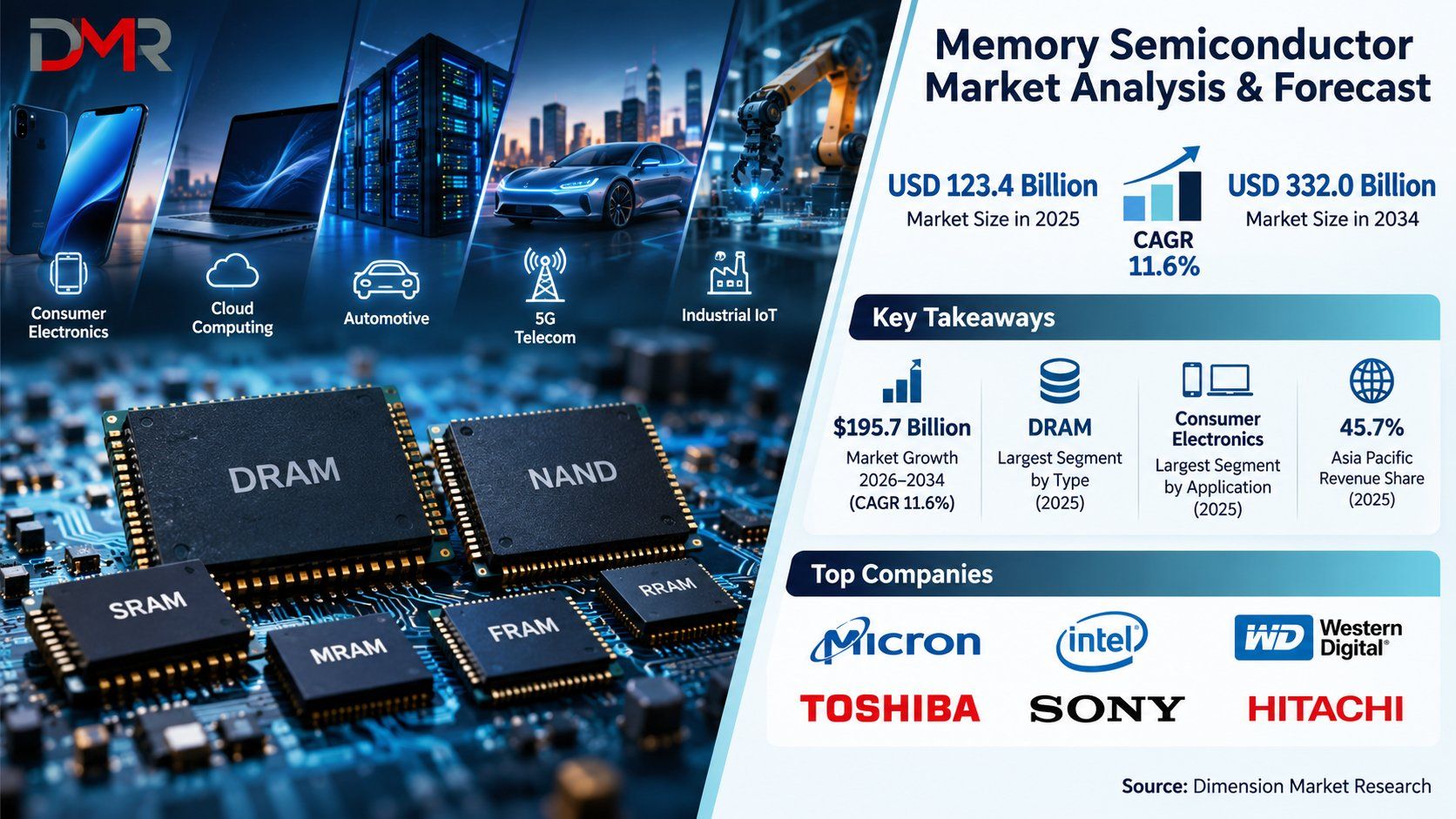
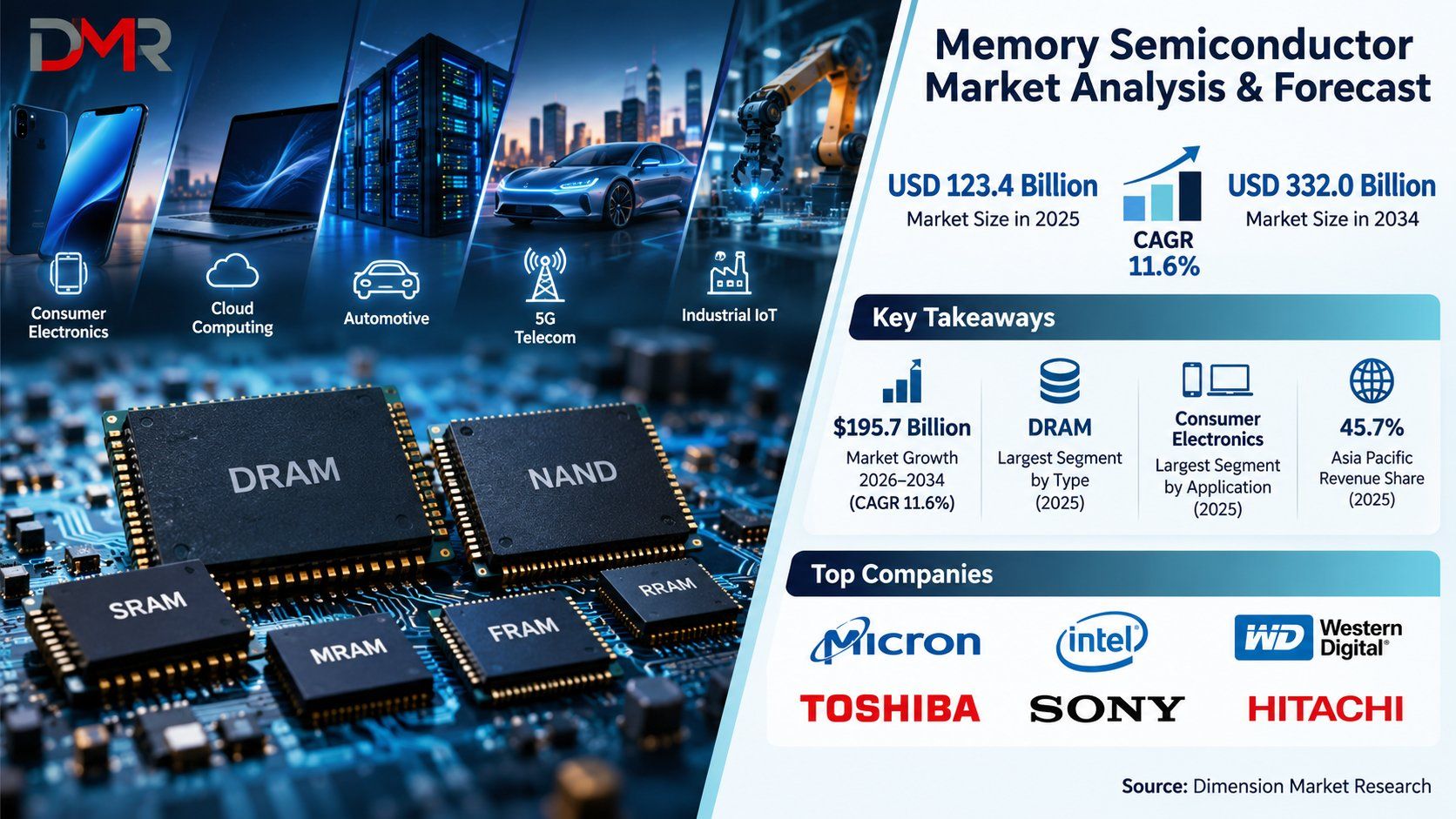
The global Memory Semiconductor Market is entering a period of strong structural growth as artificial intelligence, cloud infrastructure, connected devices, automotive electronics, and high-performance computing increase the need for faster and higher-capacity memory. According to Dimension Market Research, the global market is projected to reach USD 123.4 billion in 2025 and expand at a CAGR of 11.6% to reach USD 332.0 billion by 2034.
For businesses tracking semiconductor demand, the key point is simple: memory is no longer just a supporting component inside electronic devices. It has become a critical part of computing performance, data movement, storage capacity, and energy efficiency. DRAM and NAND Flash remain central to the market, while MRAM, FRAM, and RRAM are creating new opportunities for specialized applications.
Get insight you need (request free sample)
Why Is the Memory Semiconductor Market Growing?
Rising data generation is one of the strongest forces behind market expansion. Smartphones, laptops, servers, data centers, connected vehicles, industrial systems, and IoT devices all require memory to store and access information. The rapid adoption of AI is adding another layer of demand because AI workloads require substantial high-speed memory and storage infrastructure.
Technology development is also changing the competitive landscape. DDR5 DRAM, LPDDR solutions, advanced NAND architectures, and 3D NAND are helping manufacturers deliver higher density and better performance per watt. At the same time, system designers are looking at closer memory and processor integration to reduce latency and improve overall system efficiency.
● AI workloads are increasing demand for high-performance memory.
● Cloud infrastructure is expanding memory requirements in data centers.
● 5G is supporting growth in connected electronics and edge computing.
● Automotive electronics require faster and more reliable memory systems.
● Smart devices increasingly need greater capacity and lower power consumption.
DRAM and NAND Flash Remain Core Market Technologies
DRAM
DRAM continues to hold a leading position because of its speed and low latency. It is widely used in smartphones, PCs, laptops, gaming systems, servers, and other computing platforms. The supplied market analysis identifies DRAM as the leading type segment, with a 41.6% share in 2025.
NAND Flash
NAND Flash is closely connected with the expanding need for persistent data storage. SSDs, smartphones, enterprise storage, flash drives, and data center infrastructure depend heavily on NAND technology. Demand for higher capacity, faster read and write performance, and improved storage efficiency is supporting continued investment in NAND Flash.
Emerging Memory Technologies
MRAM, FRAM, and RRAM are gaining attention where low power consumption, endurance, speed, and non-volatility matter. These technologies can support industrial IoT, edge computing, embedded systems, automotive electronics, and other specialized applications.
How AI Is Reshaping the Memory Semiconductor Industry
AI is influencing memory semiconductor demand from both the application and manufacturing sides. AI servers process enormous datasets and require memory architectures capable of moving information quickly. This is increasing attention on high-bandwidth and high-performance memory solutions while encouraging manufacturers to improve density, efficiency, and manufacturing yields.
AI is also being applied inside semiconductor production. Machine learning can support process optimization, predictive maintenance, defect detection, yield improvement, and intelligent memory management. As AI infrastructure expands, memory requirements are likely to become an increasingly important consideration in data center design.
Get detailed market insight: https://dimensionmarketresearch.com/report/memory-semiconductor-market/
Key Applications Driving Market Demand
Consumer electronics remains the largest application area, accounting for 33.7% of market share in 2025 according to the supplied research. Smartphones, tablets, PCs, laptops, and wearables require increasingly capable memory as users expect faster applications, multitasking, larger storage, and smoother connected experiences.
Automotive is emerging as one of the fastest-growing applications. Advanced driver-assistance systems, infotainment, electric vehicles, connected cars, sensors, and autonomous driving systems generate substantial real-time data. This creates demand for memory that can deliver speed, reliability, endurance, and consistent performance under demanding conditions.
● Consumer electronics remains a major source of memory demand.
● Automotive systems are creating new high-growth opportunities.
● Data centers need scalable memory for AI and cloud workloads.
● Industrial automation is increasing demand for reliable embedded memory.
● Telecom infrastructure supports memory demand through connected systems.
Regional Outlook for the Memory Semiconductor Market
Asia Pacific
Asia Pacific leads the global Memory Semiconductor Market, with a reported 45.7% revenue share in 2025. South Korea, China, Taiwan, and Japan contribute significantly through manufacturing capabilities, electronics production, semiconductor investment, and domestic technology demand. Major memory producers and electronics companies have established strong regional ecosystems.
North America
North America is positioned as a fast-growing regional market, supported by AI infrastructure, cloud computing, data center expansion, autonomous vehicles, and semiconductor investment. The United States Memory Semiconductor Market is projected to reach USD 32.0 billion in 2025, growing at a 10.9% CAGR over the forecast period.
Europe
Europe is developing its semiconductor capabilities as demand rises across automotive, telecommunications, industrial automation, and AI-related applications. The European Memory Semiconductor Market is projected at USD 28.4 billion in 2025, with a reported CAGR of 10.5%.
Japan
Japan remains important to the memory semiconductor ecosystem because of its established semiconductor expertise and strong automotive, industrial, electronics, and telecommunications sectors. Its market is projected to reach USD 12.3 billion in 2025, with an 11.4% CAGR.
Leading Companies in the Market
● Samsung Electronics Co., Ltd.
● SK Hynix Inc.
● Micron Technology, Inc.
● Kioxia Corporation
● Western Digital Corporation
● Intel Corporation
● Nanya Technology Corporation
● Winbond Electronics Corporation
● Infineon Technologies AG
● STMicroelectronics N.V.
● Renesas Electronics Corporation
● Everspin Technologies, Inc.
Market Challenges and Opportunities
The market opportunity is substantial, but manufacturers face high fabrication costs, complex supply chains, cyclical demand, pricing pressure, raw material constraints, and geopolitical uncertainty. Semiconductor production requires sophisticated facilities and specialized equipment, making capacity planning particularly important when demand changes rapidly.
At the same time, these challenges create opportunities for companies that can improve manufacturing efficiency, diversify supply chains, develop energy-efficient memory, and target high-growth applications. AI computing, edge devices, autonomous vehicles, industrial IoT, and cloud infrastructure are especially important areas to watch.
Memory Semiconductor Market Forecast Through 2034
The long-term outlook remains positive. From USD 123.4 billion in 2025, the global market is projected to reach USD 332.0 billion by 2034. The forecast reflects rising data consumption, increasing device intelligence, AI adoption, cloud infrastructure expansion, and growing requirements for high-performance computing.
For market participants, the most important question is no longer simply how many memory chips will be sold. It is which memory technologies, applications, regions, and end users will capture the next wave of demand. DRAM and NAND Flash are expected to remain foundational, while advanced non-volatile technologies may gain ground in specialized applications.
Report Also Cover
What is the projected Memory Semiconductor Market size by 2034?
Which memory semiconductor type will dominate the market in 2026?
How is AI influencing Memory Semiconductor Market growth?
Why is automotive memory demand increasing rapidly?
Which region will lead the Memory Semiconductor Market?
What are the major applications of memory semiconductors?
How are DRAM and NAND Flash markets evolving?
Which companies are leading the Memory Semiconductor Market?
What are the major restraints affecting memory semiconductor production?
What opportunities will emerging memory technologies create?
Memory Semiconductor Market Report Details
● Market Size in 2025: USD 123.4 billion
● Forecast Value in 2034: USD 332.0 billion
● Forecast CAGR: 11.6%
● US Market Size in 2025: USD 32.0 billion
● Historical Data: 2019 to 2024
● Forecast Data: 2026 to 2034
As memory becomes increasingly important to AI, cloud computing, connected mobility, consumer electronics, and industrial digitization, understanding the market by technology, application, end user, and geography can help businesses identify where demand is moving next.
Get 10% instant discount on report purchase
Similar Topic
● Semiconductor Materials Market
● Semiconductor Manufacturing Equipment Market
About Us
Dimension Market Research (DMR) is a global market intelligence and consulting firm delivering data-driven insights that help organizations make informed strategic decisions. With expertise across 12+ industries and global markets, DMR provides syndicated reports, custom research, competitive analysis, white space analysis, and business strategy consulting.
Our research solutions combine analytical rigor, industry expertise, and forward-looking intelligence to identify opportunities, reduce risks, and support sustainable growth. Trusted by clients across diverse sectors, DMR is committed to delivering accurate, actionable insights that enable businesses to navigate evolving market landscapes with confidence.
Contact Us
Phone USA: +17323699777
Phone India: +919310023843
E-mail: [email protected]
Address USA: 957 Route 33, Suite 12 #308, Hamilton Square, NJ-08690
Address India: D44, Sector 6, Noida 201301, India